Showing posts with label foraging. Show all posts

Tuesday, June 24, 2014

Chive Blossom Vinegar


When faced with thousands of beautiful chive blossoms I think, what do we do with them? They make pretty garnishes on plates, and whimsical additions to salad when torn up.
The couple who run Maitland Mountain Farm in Salem have a lot of chives. They are sold at markets, used in flower arrangements. Chives also act as practical landscaping on the farm, maybe keeping away some insects or bunny rabbits, and most definitely serving as erosion prevention where they are planted. 
In the spring they come up with loads of spherical purple blossoms. 
We made a large batch of infused vinegar, nice to make oniony salad dressings for fresh greens. And, it's bright pink.


Chive Blossom Vinegar

Chive blossoms
White vinegar 
A wide container with a lid
A fine strainer
Nice clean jars to store the vinegar. 

Pick blossoms by spreading your fingers and running them through the chives, catching the blossoms. They will pop off the stalks to be caught in a fist. 


Wash the blossoms gently, bobbing up and down in a bowl of water. Or in my case, a huge sink. 


Strain blossoms, drip dry or spin in a lettuce spinner. 

Put the clean blossoms in a container where they fill up roughly 2/3 of the volume. Pour white vinegar in, to the top. Float a plate, or something, atop the flowers to keep them submerged, they will try to rise up and escape. Or, just put the lid on. 


Leave vinegar and chive blossoms together for 4 days to steep. It will turn bright pink and then a deeper magenta hue will develop. Keep covered well or you kitchen will smell strongly of onions. 


When the time has come to strain the entire project set up your fine strainer over a vessel to catch the strained vinegar. Use a funnel if you need to. I had to strain mine twice because the first strainer I chose filtered out the blossoms but not the tiny white seeds which float around. And the seeds look like wee insects if you didn't know what they were...so it's worth getting out a cheesecloth or a tea strainer for this case. 


Now you have plenty of jewel colored vinegar which is crystal clear. Put in pretty jars or mix up into salad dressing with olive oil. I'll put a recipe on here soon. 


Friday, May 23, 2014

Skillet Fiddlehead Ferns and Mushrooms

Fiddlehead ferns
Springtime, when shoots and flower buds are picked and eaten in their most tender moments. Fiddleheads have their moment in late May, the same time as asparagus in New England. Left to grow on the plant, each fiddlehead would unfurl into a single frond. At which point they turn tough and inedible.
A pile of fiddlehead ferns
If you find them at a good grocery store the cut edge often has turned a little brown, like cut flowers. Fresh fiddleheads should be tightly wound and feel firm not limp. Once you get them home, first wash them to dislodge the papery brown fern casing which sticks to them in places. And slice off any brown on the cut edges.

Shallot and fiddleheads
I see fiddleheads when I take walks in the Spring, but I have never picked them myself. Next year perhaps I will do some reading on how to identify the Ostrich fern which produces the edible dinner worthy sprouts. For now, I rely on others to pick them.

Cooked on high heat fiddleheads require about seven to ten minutes of cooking time. First they sear and then soften a little bit. They are best when crisp-tender. The flavor is vegetal and very mild. 

Mushrooms are a natural woodland pairing. If you have invited dancing nymphs and satyrs to dinner I would serve this. If you had morels that would be decadent. They pair nicely with onions, ramps, cream sauces, eggs and lemon. Anything which would go with asparagus is usually at home with a fiddlehead. It was beautiful with salmon and a bottle of rosé.

I made a nice side dish with ubiquitous lazy pre-sliced baby bella mushrooms, lots of olive oil and a large shallot. 


Skillet mushrooms
Skillet Fiddlehead Ferns and Mushrooms 
(about 3 servings)


2 cups sliced baby bella mushrooms
2 cups fiddlehead ferns
1 large shallot, diced
olive oil
salt and pepper

Heat a cast iron skillet on high heat. Sear the mushrooms with some olive oil and a pinch of salt, leaving them to brown before stirring them around much. 


Rinse the fiddleheads clean. Cut off any browned ends. 


When the mushrooms have some color and begin to release their juice and soften, add the fiddleheads into the pan. 


Saute the mixture, the mushrooms will finish their cooking and the fiddleheads will soften up along with them. Add a pinch of salt and a drizzle more olive oil.


When the fiddle heads are bright and halfway to tender add the shallot into the mix. Added before there is risk of burning the shallot on the high heat. Added now it will have enough time to cook while the other ingredients finish up. Stir in and saute, stirring often until the fiddleheads are crisp tender.


Serve while hot. The fiddleheads retain their curl when cooked and make for a really cool looking dinner. Happy spring!


Saturday, May 17, 2014

Pine Tiptini

I think Tiptini is a pretty good name for a drink. After foraging and syrup and vinegar making I felt quite deserving of a cocktail. It is a little gimlet, a little martini and a little pine. Let me know if you try it and like it too.


Pine Tiptini

1 1/2 ounces gin
1/4 ounce of dry vermouth
1/3 ounce lime juice
1 tbs of spruce tip syrup (see recipe here)


Shake vigorously over ice, strain. Pour into a pretty glass. Garnish with a fresh evergreen tip or slice of lime.

Drink outside, savoring the existence of spring breezes, yellow dandelions and honey bees.


Spruce Tips, Part 2: Evergreen Cocktail Syrup


Spruce tips to be cooked with sugar
Besides being good in salads, spruce tip syrup is a grand addition to your cocktail bar. Steeped for a day to allow the puzzling flavors and smells of pine tree to infuse the sugar syrup. I like to use it in cocktails, but added to seltzer water is nice, or a sorbet. Many options. Spruce tip syrup can be used much like elderflower liqueur, it is very good with gin or vodka. Pairs well with lemon and lime.

And it is easy as pie to make. Increase the sugar and water content to the amount of spruce tips you have collected. It is a dead simple 1:1:1 ratio.


Spruce tip simple syrup
Spruce Tip Syrup

1 cup spruce tips
1 cup sugar
1 cup water

Put all the ingredients into an appropriately sized pot. Bring it to a simmer over medium heat. Simmer until the sugar has dissolved and the liquid around the tips is as clear as water. Turn off the heat.

Set the pot aside, covered, to steep for 8 hours. A little more or a little less wont kill it, I find 8 hours is a suitable amount of time for the flavors to be extracted.

Bottled Spruce Tip Cocktail Syrup
Strain the syrup with a fine mesh strainer. Place a funnel in the bottle to be filled, the strainer held over that, and carefully pour the syrup through it. Use the back of a spoon to press extra syrup from the collected evergreen tips.

Your golden syrup will last months and months unless it is drank first.


Spruce Tip Part 1: Vinegar

Spruce Tips
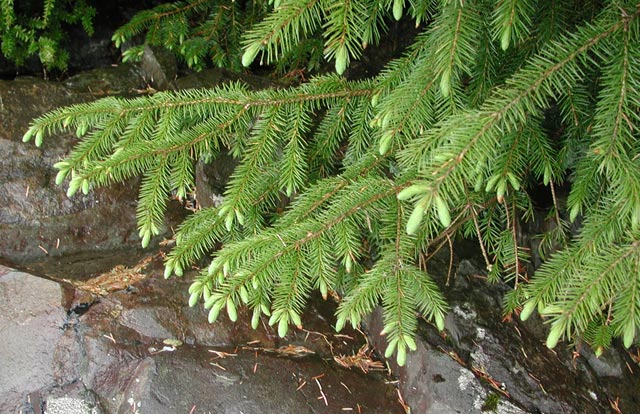
Spruce tips are an unusual food, available only for a week or two in the Spring and to those to are willing to forage for some adventurous flavor. Quite simply spruce tips are the brand new green growth of evergreen trees. At the end of each branch a little bud of brown appears, it grows until the brown paper pops off and blows away. Tender neon green nubs are revealed. The tips.

Step 1: Make sure the tree in question is in a healthy environment, no pesticides, not too close to a road, you are going to eat them, basic rules apply.

Step 2: Sample your tree, pinch off one tender tip and eat it, tasting if it is a good tree. All trees have a unique taste. Some are horrible and resinous you will want to spit them out. The good ones taste like lemon and christmas trees and something mysterious and spicy. You will know a good tree when you find it.

Step 3: Collect the evergreen tips in a bag. Know that you are essentially pruning the tree where you pinch off tips. So like any other harvesting from nature, pick a little here and a little there, not decimating one spot over another, and leaving some for the tree.

Spruce TIps
Bring the found tips home and sort through them, the little pile to the right in this picture is all the removed bits, a few sticks, older pine needles, brown paper casings and evergreen flowers which got picked along with the tips.

Spruce tips are primarily an ingredient for flavor. I hear some people make tea or beer with them. I make two simple things, an infused vinegar and a simple syrup (recipe to follow in the next post.) The vinegar is infused for four weeks and makes amazing salad dressings, imparting a tantalizing pine note to normal salad greens. Not specifically tasting like a pine trees, it tastes like the smell of a christmas tree when you think "that smells really good."


Spruce Tip Vinegar
1 cup spruce tips
Spruce Tip Vinegar Day 1
2 cups white vinegar (or apple cider)
1 jar

Sort any debris from the pile of spruce tips. I cant see any reason to wash them. Place them in the jar and pour the vinegar over. Close it tight.
Shake the jar once a day for four weeks.
Once infused, pour the vinegar through a strainer into your chosen vinegar bottle. The tips will be strained out, they are very broken down at this point, discard them.


To make a salad dressing, mix 1 part spruce tip vinegar to 3 parts extra virgin olive oil, and a pinch of salt and pepper. Shake up well and enjoy.